Table of Contents
Introduction
A cat tree for large cats is no longer a niche product for a small group of pet owners. As more indoor cats live in apartments, family homes, cat cafés, and multi-cat households, buyers are looking for cat furniture that feels safer, lasts longer, and fits modern interiors. For retailers, distributors, and private-label pet brands, this creates a clear opportunity: large-cat-friendly cat trees can stand out from standard lightweight models.
But designing a cat tree for large cats is not as simple as making a regular cat tree taller or wider. Bigger cats create stronger landing force, need more turning space, and often test the structure more aggressively when they climb, scratch, or jump between levels. A product that looks attractive in photos may still fail in real use if the base is too narrow, the posts are too thin, or the platforms are not arranged around natural feline movement.
For global buyers, the real question is not only “Does this cat tree look good?” The better question is: “Can this product stay stable, comfortable, and marketable after months of daily use by heavier cats?”
As a professional pet furniture manufacturer, Hanyang focuses on cat trees, cat beds, and cat furniture solutions for global pet brands, wholesalers, and distributors. This guide explains how to evaluate a cat tree for large cats from a practical manufacturing and sourcing perspective.
Why Large Cats Need a Different Cat Tree Design
Large cats do not use cat trees gently. They jump onto platforms at an angle, push off from posts, stretch their full body against scratching surfaces, and often prefer higher resting points where they can observe the room. A standard cat tree may work for kittens or smaller cats, but it can feel unstable when used by bigger breeds or heavy adult cats.
A cat tree for large cats must solve three problems at the same time.
First, it must provide physical support. Bigger cats need wider platforms, stronger posts, and a heavier or better-balanced base. If the structure shakes when the cat lands, the cat may avoid using it.
Second, it must provide behavioral value. Cats need places to climb, scratch, hide, perch, and rest. Environmental enrichment is especially important for indoor cats because it helps them express natural behavior inside the home. Research and veterinary guidance on environmental enrichment for indoor cats repeatedly mention the value of vertical space, scratching outlets, and resting areas.
Third, it must fit the buyer’s market. A large cat tree should not only be strong; it should also be attractive, easy to assemble, efficient to pack, and suitable for the target customer’s home style.
What Buyers Should Look for in a Cat Tree for Large Cats
A well-designed cat tree for large cats should feel stable from the bottom up. Buyers should not judge only by height, number of platforms, or product photos. The more important details are structural balance, connection strength, material density, and platform usability.
A strong large cat tree usually includes:
| Design Area | What to Check | Why It Matters for Large Cats |
|---|---|---|
| Base structure | Wide base, balanced weight, anti-wobble layout | Reduces tipping risk during jumping and climbing |
| Main posts | Thick posts with strong internal support | Handles scratching, leaning, and lateral force |
| Platforms | Wider resting and landing areas | Gives larger cats enough room to turn and lie down |
| Scratching zones | Tall sisal-covered areas | Allows full-body stretching and claw maintenance |
| Condos or caves | Larger openings and usable inner space | Prevents the enclosed area from becoming decorative only |
| Fabric surface | Comfortable, durable, and easy to maintain | Improves long-term customer satisfaction |
| Assembly system | Clear hardware, strong joints, simple instructions | Reduces returns and customer complaints |
| Packaging | Reinforced export packaging | Protects components during international shipping |
For B2B buyers, this checklist is especially useful when comparing samples from different suppliers. A product may look similar online, but the structure, material, and assembly quality can create a completely different user experience.
Stability Comes Before Decoration
The first test of a cat tree for large cats is stability. Decorative shapes, plush fabric, hanging toys, and color matching are valuable, but they cannot compensate for a weak structure.
Large cats generate uneven force when they land. They may jump onto the top platform from a sofa, leap down from a window ledge, or climb the side of the tree instead of using the intended path. Because of this, the base should be designed to resist side-to-side movement, not just vertical pressure.
A stable cat tree usually has a low center of gravity, strong post-to-base connection, and logical platform placement. If all heavy elements are placed high without enough lower support, the tree may wobble. If the platforms extend too far from the central posts, the structure may twist under movement.
For product development, this means the engineering should start with the cat’s movement path. Where will the cat jump first? Where will it land? Where will it scratch? Which platform carries the most weight? These questions should be answered before deciding the final shape.
Buyers reviewing samples should gently push the structure from different angles, check whether the posts loosen after repeated movement, and observe whether the upper levels feel secure. A premium-looking large cat tree that shakes during use will quickly lose customer trust.
Platform Size Should Match Real Cat Behavior
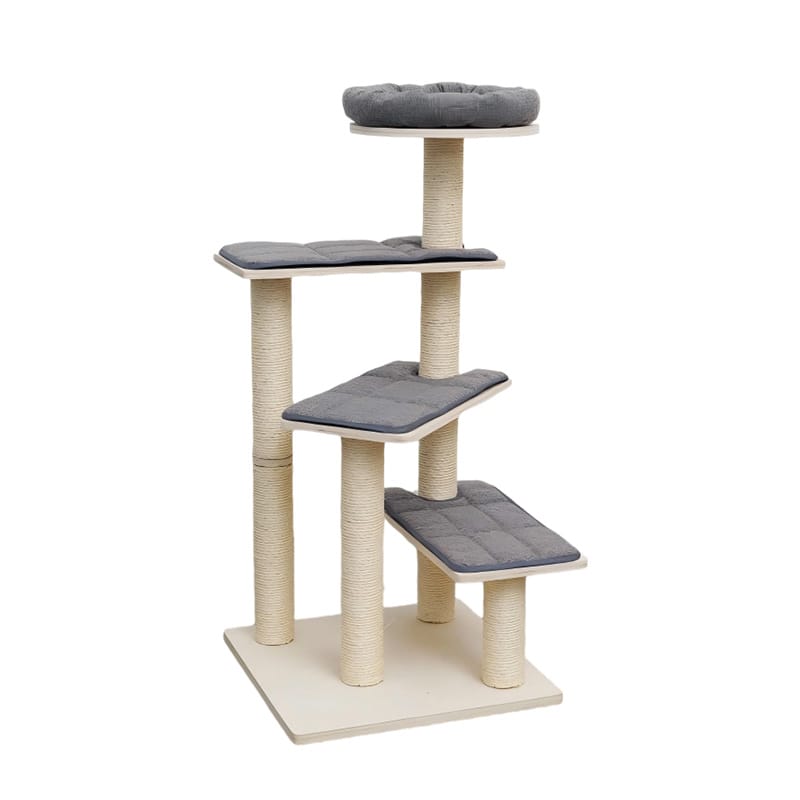
A common mistake in large cat tree design is adding more platforms without increasing usable space. For larger cats, a small platform may only work as a step, not as a resting area. If the cat cannot turn around, stretch, or lie down comfortably, the platform becomes less valuable.
A cat tree for large cats should include at least one or two main resting platforms that are truly usable. These platforms should support the cat’s body without forcing it to curl tightly. Rounded or cloud-shaped platforms can work well if the usable surface is wide enough and the edge does not interfere with movement.
For retail buyers, platform size is also a selling point. Product pages can explain that wider platforms are designed for bigger adult cats, multi-cat homes, or cats that prefer spacious resting zones. This turns a technical design feature into a marketable benefit.
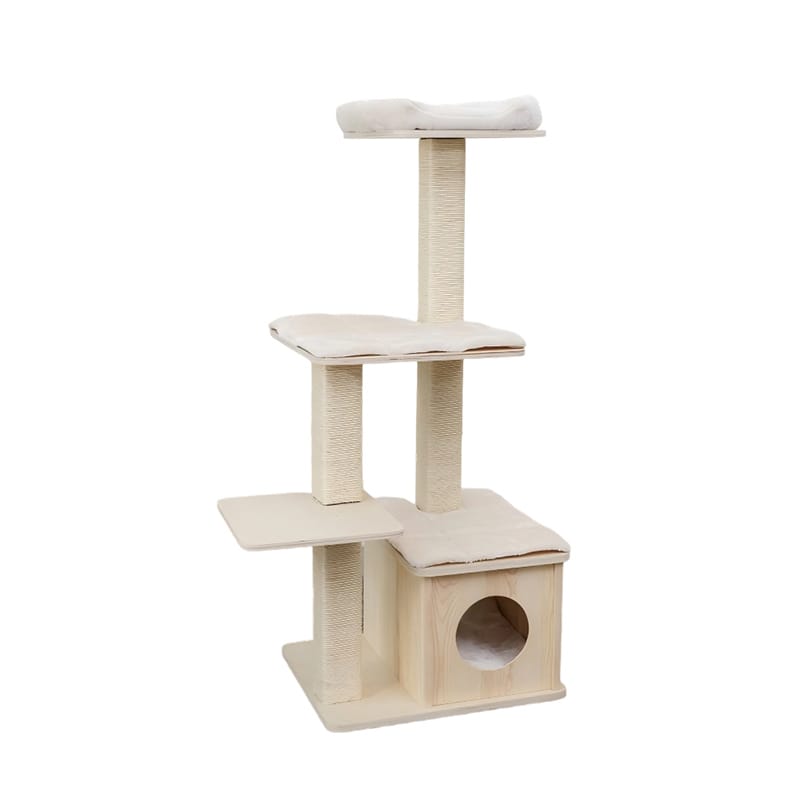
Hanyang’s solid wood cloud cat tree is a useful example of how natural wood structure, multiple plush platforms, sisal elements, and a cat cave can be combined into a functional indoor cat furniture design.
Scratching Areas Need More Than Sisal Rope
Scratching is not a bad habit; it is normal feline behavior. According to VCA Hospitals cat enrichment guidance, scratching helps cats deposit scent signals and feel secure in their environment. For a cat tree for large cats, the scratching area must be large enough and strong enough for full-body stretching.
This is where many low-quality products fail. The sisal may be too thin, the post may be too short, or the rope may loosen after repeated scratching. Bigger cats can apply more force when they stretch vertically, so the post needs a stronger internal structure and secure wrapping.
For OEM buyers, sisal quality should be tested during sample review. Check whether the rope is tightly wrapped, whether the end points are secure, and whether the post remains firm when pulled. If the scratching surface feels weak in the sample stage, it will usually perform worse after bulk use.
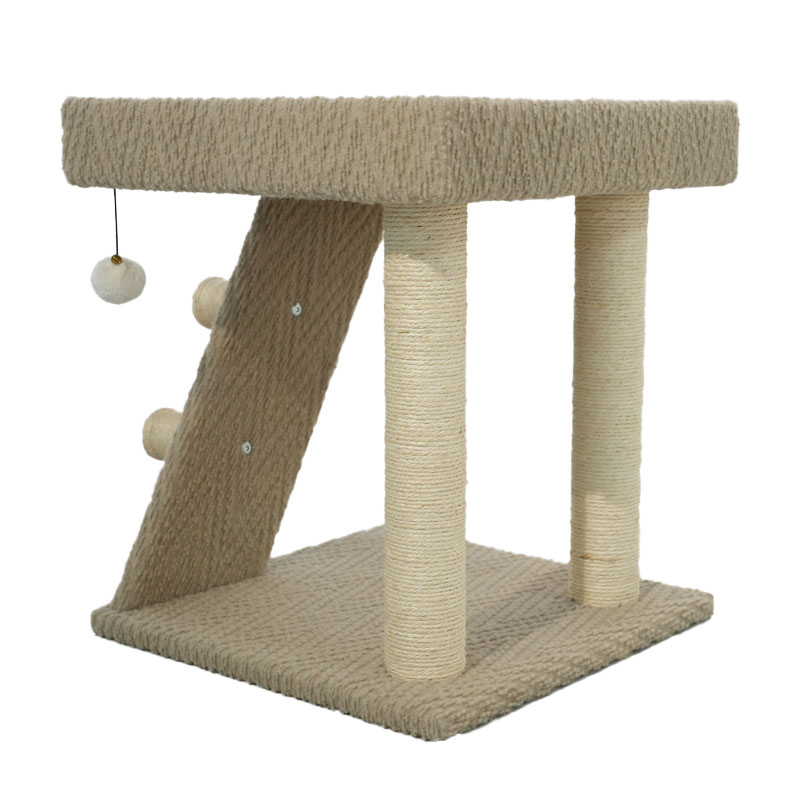
A good large cat tree should offer different scratching opportunities, such as vertical posts, inclined scratching boards, or sisal-lined cave surfaces. This gives cats more choice and increases daily usage.
Materials Decide the Long-Term Value
Material selection affects stability, durability, appearance, and customer reviews. A cat tree for large cats should not rely on thin boards or weak post cores. The larger the intended user, the more important the internal structure becomes.
Common material considerations include:
| Material Component | Better Choice for Large Cats | Buyer Concern |
| Load-bearing frame | Solid wood or reinforced wood panels | Stability and lifespan |
| Scratching surface | Natural sisal rope or sisal mat | Scratch resistance and cat acceptance |
| Cushion surface | Soft but durable plush or fabric | Comfort and appearance |
| Inner connectors | Strong screws, brackets, or reinforced joints | Long-term anti-wobble performance |
| Base panel | Thicker, heavier, or wider panel | Tip resistance |
| Optional eco materials | Documented wood sourcing or safer material options | Brand positioning and compliance needs |
Some buyers also ask about sustainable sourcing. In that case, suppliers should be ready to discuss material documentation. For example, buyers targeting eco-conscious markets may want to understand wood sourcing standards such as those explained by the Forest Stewardship Council, depending on their product positioning and target market requirements.
The key is not to use “premium material” as an empty phrase. Buyers should ask what part of the structure uses which material, how the posts are reinforced, and how the final product is tested.
Large Cat Trees Should Still Look Good in Modern Homes
A heavy duty cat tree does not need to look bulky or outdated. In many markets, pet owners now want cat furniture that blends with home décor. Neutral colors, natural wood textures, soft shapes, and minimalist lines can make a large cat tree easier to place in living rooms, bedrooms, and apartments.
This matters for retailers because the purchase decision is not only functional. The cat owner is also asking:
Will this fit my interior style?
Will it look too heavy in a small apartment?
Can I place it near a window, sofa, or reading corner?
Does it look like furniture rather than a temporary pet accessory?
A modern cat tree for large cats should balance strength and aesthetics. Solid wood branches, plush cushions, cloud platforms, clean fabric finishes, and practical scratching posts can create a product that feels both safe for cats and acceptable for design-conscious customers.
For buyers building a private-label line, this is a strong product direction. A large-cat-friendly design can be positioned around comfort, stability, and interior harmony instead of only size.
A Better Product Page Starts With Better Product Logic
For e-commerce sellers and distributors, a cat tree for large cats needs clear product communication. Many product pages make the mistake of using generic phrases such as “strong,” “durable,” or “high quality” without explaining what those words mean.
A more effective product page should describe:
Who the product is for
What makes the structure stable
Which parts are suitable for larger cats
How cats use the platforms, posts, and cave
What materials are used
How the product supports climbing, scratching, resting, and hiding
What type of home environment it fits
For example, instead of saying “strong cat tree,” a better description would be:
“Designed with a wider base, reinforced posts, and spacious resting platforms, this cat tree for large cats supports everyday climbing, scratching, and lounging for bigger indoor cats.”
That sentence gives buyers and end customers a clearer reason to trust the product.
For more general product quality guidance, buyers can also read Hanyang’s guide on how to choose a high quality cat tree.
OEM Design Details That Make a Large Cat Tree Easier to Sell
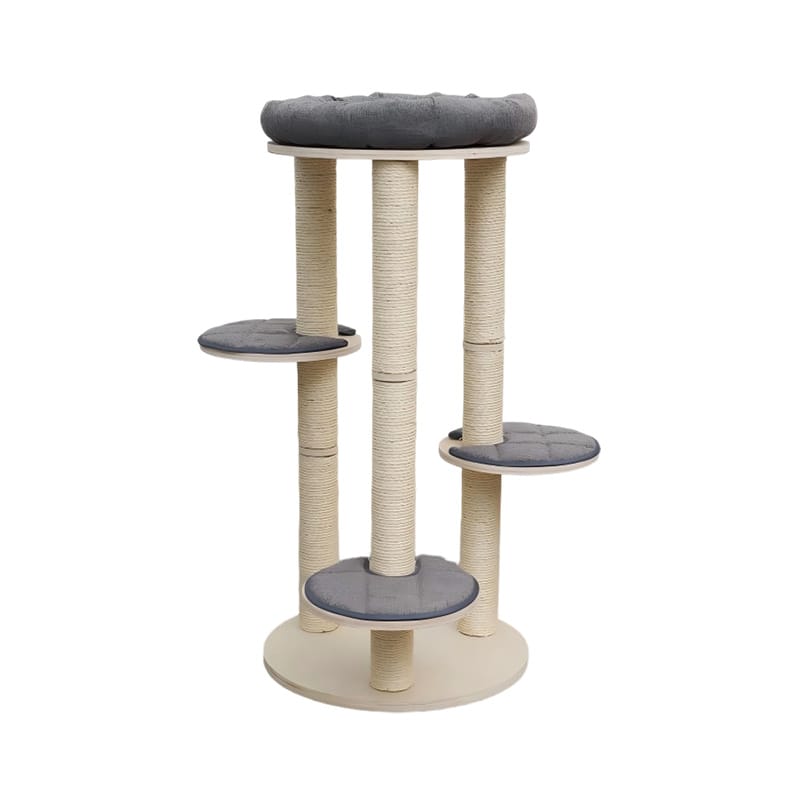
For private-label buyers, a cat tree for large cats can be developed in several directions. The best choice depends on the target market, sales channel, and customer profile.
Here are several OEM design angles worth considering:
| OEM Direction | Best For | Product Design Focus |
| Modern large cat tree | Home décor retailers and online stores | Neutral colors, clean lines, wood elements |
| Multi-cat large cat tree | Families with more than one cat | Multiple platforms, wider base, extra scratching zones |
| Apartment-friendly large cat tree | Urban markets | Vertical design, compact footprint, strong balance |
| Luxury large cat tree | Premium pet furniture brands | Better fabrics, refined shapes, natural textures |
| Cat café large cat tree | Commercial spaces | Strong wear resistance, easy cleaning, multi-cat use |
| Private label cat tree | Pet brands and distributors | Custom color, logo, packaging, and product series design |
A reliable cat tree furniture manufacturer guide can help buyers understand how supplier selection, customization ability, and quality control influence the final product.
When developing an OEM large cat tree, buyers should avoid changing only the color or logo. The real competitive advantage comes from product structure: wider platforms, better post placement, stronger materials, and a design that solves real customer concerns.
Sample Testing: What Buyers Should Check Before Bulk Orders
Before placing a bulk order, buyers should test a sample carefully. This is especially important for a cat tree for large cats because small weaknesses can become serious problems after repeated use.
A practical sample test should include:
Checking whether the base stays flat and stable
Testing whether posts loosen after movement
Looking for sharp edges or rough finishing
Confirming that platforms are wide enough for large cats
Checking whether the cave opening is usable
Testing fabric attachment and sisal wrapping
Reviewing assembly steps from a customer’s perspective
Checking carton protection and component organization
A sample should not only be inspected visually. It should be assembled, moved, lightly shaken, and reviewed as if it were already in a customer’s home. If the product is difficult to assemble, unstable after assembly, or unclear in its instructions, those issues may lead to returns or poor reviews.
Example Sourcing Scenario: Building a Large Cat Tree Product Line
Imagine a pet product distributor wants to expand from basic cat furniture into a more premium indoor cat furniture series. Their customers often ask for products suitable for bigger adult cats, but many standard models receive complaints about wobbling or small platforms.
Instead of choosing another regular cat tree, the buyer develops a product line around three models:
A compact apartment cat tree for large cats
A multi-level cat tree for big cats and multi-cat homes
A modern solid wood style cat tree for design-focused customers
For the first model, the focus is small footprint and better balance. For the second, the focus is multiple large platforms and extra scratching posts. For the third, the focus is visual appeal, natural materials, and premium home décor value.
This approach gives the buyer a clearer category strategy. Instead of selling random cat trees, they can build a series around large-cat needs, stable structure, and modern indoor living. That makes the product easier to explain on websites, in catalogs, and in distributor sales materials.
How Hanyang Supports Large Cat Tree Buyers
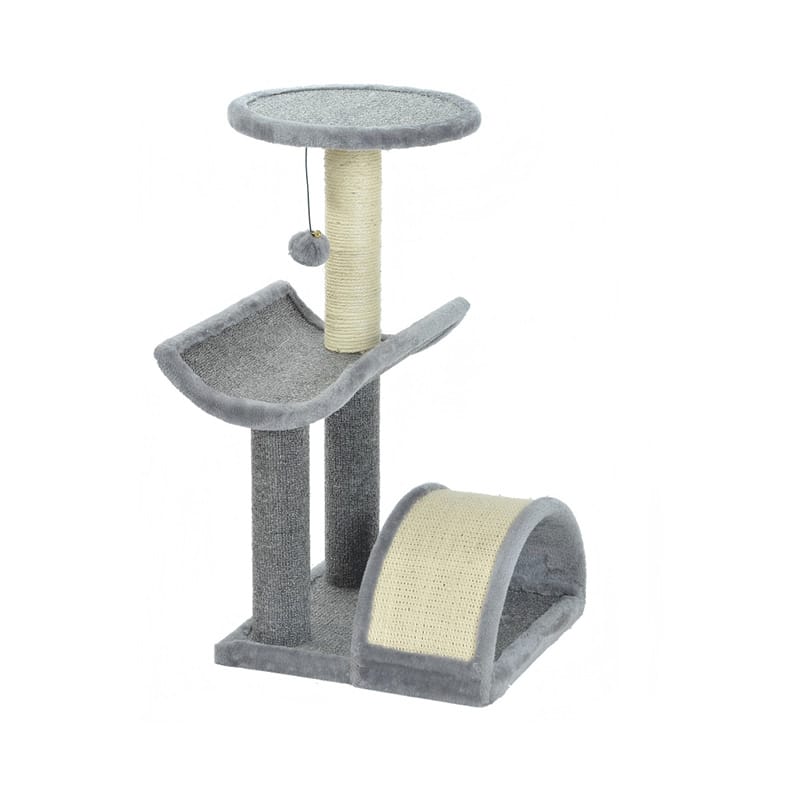
Hanyang provides manufacturing support for global pet brands, wholesalers, and distributors looking for reliable cat furniture products. For buyers developing a cat tree for large cats, the key value is not only production capacity. It is the ability to turn product requirements into practical, manufacturable designs.
Buyers can work with Hanyang on:
Cat tree structure planning
Material selection
Platform and post design
Color and fabric customization
Private label packaging
Bulk production coordination
Export-ready product support
Product series development
You can explore more cat furniture products or contact Hanyang to discuss custom requirements for your market.
Conclusion
A cat tree for large cats must be designed around real feline movement, not only product appearance. Bigger cats need stronger support, wider platforms, better scratching areas, and a structure that stays stable under repeated climbing and jumping.
For retailers, distributors, and private-label pet brands, this category offers strong potential because it solves a visible customer pain point: many standard cat trees are not comfortable or stable enough for larger cats. A better-designed product can reduce complaints, improve customer satisfaction, and create a clearer selling proposition.
The best large cat tree is not simply the tallest or heaviest model. It is the one that combines stable engineering, cat-friendly behavior design, durable materials, modern appearance, and reliable manufacturing control.
If your business is planning to develop a stable cat tree for large cats, Hanyang can support OEM and ODM product development from concept to production.
FAQ
What makes a cat tree for large cats different from a regular cat tree?
A cat tree for large cats usually has a wider base, stronger posts, larger platforms, and better weight distribution. These features help the structure stay stable when bigger cats jump, climb, scratch, or rest.
Is a taller cat tree always better for large cats?
Not always. Height is useful, but stability matters more. A tall cat tree with a narrow base may wobble, while a medium-height model with a strong structure and wide platforms may be safer and more comfortable.
What materials are better for a large cat tree?
Solid wood, reinforced wood panels, natural sisal, durable fabric, and strong hardware are commonly preferred for large cat tree designs. The best material choice depends on the target market and product positioning.
Why do large cats avoid some cat trees?
Large cats may avoid a cat tree if it feels unstable, has platforms that are too small, or uses surfaces that are uncomfortable for resting or scratching. Cats often stop using furniture that does not feel secure.
Can a cat tree for large cats also work in apartments?
Yes. Apartment-friendly large cat trees should use vertical space efficiently while keeping a stable base. A compact footprint, balanced structure, and practical platform layout are important.
What should buyers check when ordering OEM large cat trees?
Buyers should check structure stability, post strength, platform size, material quality, assembly process, packaging protection, and customization options before confirming bulk production.
Can Hanyang customize a cat tree for large cats?
Yes. Hanyang supports OEM and ODM customization for cat trees, cat beds, and cat furniture products, including structure, materials, colors, packaging, and private-label requirements.
Where can I request a custom large cat tree solution?
You can contact the Hanyang team through the Contact Us page and share your target market, product style, material preferences, and customization requirements.